
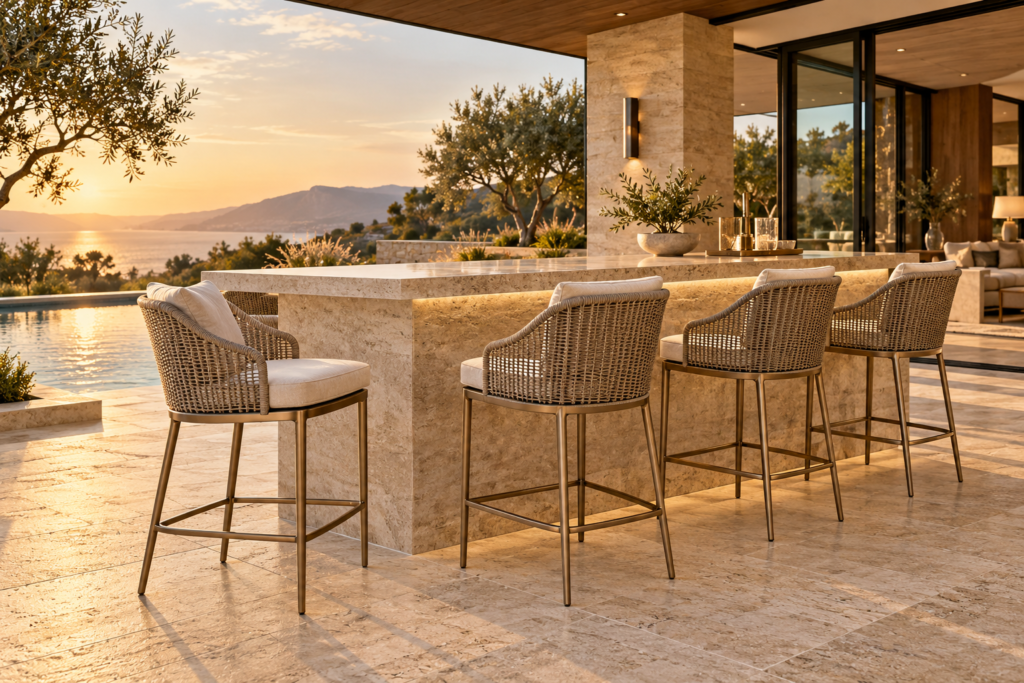
A patio chair can look right beside a table and still feel wrong the moment you sit down. The seat may leave too little legroom, the arms may catch beneath the tabletop, or the footrest may be out of reach.
Choosing bar height patio chairs starts with the table you’ll use them with. Once the measurements work, comfort, materials, and everyday upkeep become much easier to compare. The goal is seating that fits your space and feels comfortable long after the first few minutes.
Homepatiolife Mission Statement
Homepatiolife helps homeowners, renters, and home lovers make informed choices for practical, comfortable, and welcoming living spaces.
Short Definition
Bar height patio chairs are tall outdoor seats, typically measuring 28–32 inches from floor to seat, designed for raised tables. Choosing compatible dimensions helps provide comfortable table access and legroom.
What Seat Height Fits Your Patio Table?
Bar-height patio chairs typically have seats around 28–32 inches above the floor and pair with tables approximately 40–42 inches high. These ranges are a starting point, not a guarantee of compatibility. Check the chair’s actual seat height alongside your table’s surface height, underside clearance, and any supports beneath it. =
Bar Height Vs. Counter Height
Bar-height and counter-height seating serve different surfaces. A chair intended for a raised bar can leave you sitting too high at an outdoor kitchen counter.
| Seating category | Typical seat height | Typical table or counter height |
| Counter height | 24–27 inches | 34–37 inches |
| Bar height | 28–32 inches | 40–42 inches |
These manufacturer reference ranges vary across furniture collections. Don’t assume every seat within a category fits every table in the corresponding range.
Terms such as “pub height” and “high-top” can help you find products, but they don’t replace measurements. An outdoor kitchen island may need counter-height stools even when a nearby freestanding table needs taller chairs.
Seat Height Vs. Overall Chair Height
Seat height measures from the floor to the sitting surface. Overall height usually measures to the highest point of the chair, often the backrest.
For example, a hypothetical listing showing a 46-inch overall height and a 30-inch seat height describes two different dimensions. The 30-inch measurement matters when checking seating height against your table.
Look for a dimension diagram. When a listing says only “height,” ask the seller which measurement it means.
Measure Your Table And Available Seating Space
Measure both the table and the area around it before choosing chairs. You need enough room for legs beneath the surface, armrests where you want chairs to tuck in, and movement around occupied seats. A chair that fits under a table may still crowd the patio.
Check The Tabletop, Underside, And Supports
Record three measurements:
- Floor to tabletop: Establishes the surface height you’ll eat or rest your arms on.
- Floor to the lowest obstruction: Includes an apron, drawer, or support rail beneath the edge.
- Usable space between supports: Shows where knees and chair legs can fit.
An apron is the panel or framework immediately below the tabletop. A deep apron can reduce legroom even when the table’s surface height appears suitable.
As a hypothetical example, a 42-inch table paired with a 30-inch seat creates a 12-inch difference between the seat and tabletop. But an apron extending several inches below the top reduces the available opening. Those measurements describe different aspects of fit.
Compare the dimensions with a table-and-chair combination you already find comfortable. For uncertain pairings, ask the manufacturer to confirm compatibility.
Account For Cushions And Armrests
Check whether the published seat height includes the cushion. An added cushion raises the sitting surface, although the amount depends on its thickness and compression.
Armrests need their own clearance check. Measure to the top of the arm and compare it with the lowest table edge it must pass beneath.
Also check how far the chair can slide inward. A pedestal base or crossbar may stop the legs before the seat reaches the position you expected.
Allow Room Between And Behind Chairs
Chair width, spacing between seats, and room behind them are separate measurements.
Use painter’s tape to mark each chair’s full footprint on the patio. Include projecting arms and legs, then allow for pulling the chair out and walking behind an occupied seat.
For a hypothetical 96-inch seating run, four equal positions provide 24 inches per position. That calculation alone doesn’t establish comfort: wide arms, end supports, and access at either end may make three chairs more practical.
Don’t buy outdoor bar height chairs in a set of four simply because the package suits your budget. Confirm the usable seating count first.
Check Comfort Beyond The Measurements
The right height gets you close to the table. Seat shape and support determine whether you’ll want to stay there.
During a sit test, check whether:
- Your feet reach the footrest without stretching.
- The seat supports your thighs without pressing behind your knees.
- The backrest feels supportive in your normal sitting position.
- The usable width feels comfortable between the arms.
- You can get seated and stand up without awkward maneuvering.
A deep, reclined seat may suit relaxed conversation but feel inconvenient for eating. A more upright chair may work better for regular outdoor meals.
Consider who will use the seating most often. Tall chairs can be difficult for some guests to access, so assess the complete seating arrangement rather than choosing height for appearance alone.
When shopping online, prioritize usable seat dimensions and clear photographs. Reviews can reveal questions worth investigating, but another buyer’s comfort doesn’t establish your own.
Choose Materials That Suit Your Outdoor Conditions
Material names help narrow your choices, but the complete construction matters. A wicker chair has an underlying frame; a metal chair also has hardware, joints, and a finish.
| Material | What to evaluate | Ownership consideration |
| Aluminum or cast aluminum | Finish, joints, hardware, chair weight | Check care requirements and suitability for your exposure |
| Steel | Protective coating, fasteners, damaged areas | Inspect and maintain the finish as directed |
| Resin wicker | Weave condition, underlying frame, outdoor-use specifications | Check cleaning instructions and replacement options |
| Teak or other outdoor wood | Species, construction, finish, care guidance | Decide whether you accept weathering or want to maintain the original appearance |
| HDPE poly lumber | Product specifications, hardware, weight, warranty | Low-maintenance claims still require product-specific checks |
Avoid treating “weatherproof” as a complete specification. Ask what the manufacturer actually permits and what maintenance the warranty expects.
An uncovered coastal patio presents different demands from a sheltered porch. Consider salt exposure, frequent rain, direct sun, and how easily you can move the chairs into storage.
Be cautious with absolute durability claims. For example, POLYWOOD’s residential warranty acknowledges that sunlight can cause some fading despite UV stabilizers. That is more useful buying context than a blanket promise that poly lumber never fades.
For occasional use on a covered patio, a simpler chair may be sufficient. For frequent meals, give greater weight to comfortable construction, serviceable parts, and realistic care requirements.
Plan For Cleaning, Cushions, And Storage
Choose a care routine you’re willing to follow. Chairs with intricate frames or tightly woven seats may require more detailed cleaning than simpler designs.
Read the care instructions before buying cushions. Removable covers aren’t automatically machine washable, and a fabric’s water resistance doesn’t establish how quickly the complete cushion will dry.
Sunbrella’s own guidance distinguishes fabrics with different levels of water resistance. Check the specific fabric and cushion construction rather than relying on the brand name alone.
For an exposed patio, consider where wet cushions will dry and where you’ll store them when needed. Check cover dimensions against the chair’s full height, width, and depth.
Replacement availability also affects value. Before purchasing an unusual seat shape, see whether replacement cushions, glides, and other service parts are available.
Stackable chairs can simplify storage, but confirm that the exact model is designed to stack and follow its stacking instructions.
Choose Features That Work With Your Layout
Features are useful when they solve a specific problem. Start with how you’ll sit, move, and store the furniture, then decide which options justify their cost and footprint.
Swivel Vs. Stationary Chairs
Swivel outdoor bar stools let you turn toward a conversation without repositioning the whole chair. They may also make access more convenient in some layouts.
However, rotating arms and backrests need room. A chair that clears the table while facing forward may strike it when turned.
Check the swivel range, rotating footprint, and mechanism care instructions. Don’t assume every model rotates through a full circle.
Stationary chairs have fewer moving components and may suit a straightforward dining layout. You’ll still need space to pull them out. Neither design makes an unsuitable or uneven surface appropriate for use.
Backs, Arms, And Stackable Designs
Bar height patio chairs with backs provide a place to lean during longer conversations. Backless stools offer a lower visual profile and may tuck away more readily, depending on the design.
Arms provide somewhere to rest your elbows but can restrict usable seat width and interfere with table clearance. Armless chairs may be easier to arrange closely, though guests still need comfortable spacing.
For seasonal storage, compare the dimensions of the stacked chairs with the available storage area. A stackable design is only useful when you can safely handle and store the stack.
Check The Product Details And Purchase Terms
Before ordering, compare the exact model specifications rather than relying on the main photograph.
Confirm:
- Seat height, usable width and depth, arm height, and full footprint.
- Whether cushions are included in the dimensions and purchase price.
- Manufacturer load limits and intended outdoor use.
- Assembly requirements and maintenance instructions.
- Number of chairs included.
- Replacement-part availability.
- Warranty coverage and exclusions.
- Return shipping, restocking fees, and restrictions on assembled furniture.
Check the selected variant carefully. A single product page may offer both counter-height and bar-height versions.
Price comparisons should include the complete purchase. A lower-priced chair may be suitable, but additional cushions, delivery, or difficult returns can change its value.
Follow placement instructions and consider access for the intended users. Keep furniture from creating climbing opportunities near deck or balcony guards. Any proposed alteration to a guard or other structural feature calls for qualified local advice.
Frequently Asked Questions
What If My Outdoor Bar Is Taller Than The Usual Bar-Height Range?
Choose seating from the actual measurements rather than moving automatically to the tallest available stool. Record the surface height, underside clearance, and supports, then ask the manufacturer about compatible seating. Extra-tall options may be relevant, but footrest reach, access, and the complete chair dimensions still need checking.
Can I Mix Patio Chairs And Tables From Different Brands?
Yes, provided the measurements and construction work together. Matching “bar height” labels don’t guarantee compatibility across brands. Check seat height, arm clearance, knee space, and interference from table supports. For sets used regularly for meals, test the pairing where possible or obtain clear compatibility guidance before ordering.
Can Bar Height Patio Chairs Stay Outside Year-Round?
Some models are intended for year-round outdoor use, while others require protection or seasonal storage. Follow the exact manufacturer’s care instructions and warranty conditions. Evaluate cushions and moving parts separately from the frame, and account for your patio’s exposure rather than assuming every outdoor chair has identical requirements.
Do Bar Height Patio Chairs Need Cushions?
No. Whether cushions improve comfort depends on the seat shape, material, and your preference. Try the chair without one where possible. Adding a cushion changes the sitting height and introduces cleaning, drying, and storage needs, so check both comfort and table clearance before choosing a cushion-dependent setup.
Final Buying Checklist: Confirm The Fit Before You Order
Confirm the seat-to-table relationship, underside legroom, arm clearance, footrest reach, and space around occupied chairs. Then check that the materials, care requirements, and purchase terms suit your household.
The right bar height patio chairs should let you sit comfortably, use the table naturally, and move through the patio without rearranging the furniture. Start with those practical checks, then choose the style you’ll enjoy living with.
Disclaimer
This content is for general informational purposes only. Homes, needs, preferences, budgets, and situations vary. Seek qualified advice for safety concerns, installation, repairs, legal matters, structural changes, electrical, plumbing, HVAC, or major property decisions.